
Before you decide what to say, decide who you’re talking to. The heart of PizzaSMARTS is a simple grading system that sorts everyone in your delivery area into one of four groups by what they’ve actually done: how recently and how often they’ve ordered.
From the 1997 manual
“Nothing predicts purchasing potential better than previous purchasing activity. The information within your sales records allows you to divide your customers into the most significant and relevant marketing groups. They are grouped by how they feel about your business, as expressed by their purchasing patterns.”
Divide and Conquer, Analyzing Market
The four grades
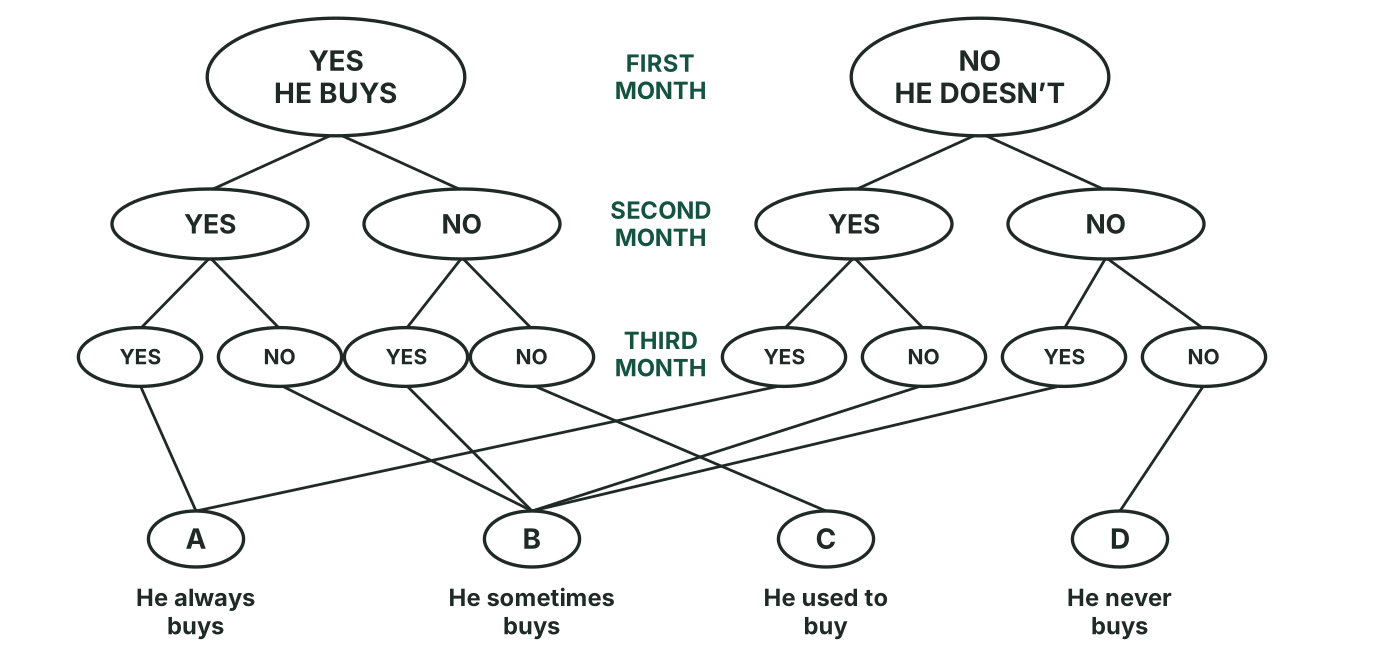
The original system looked at each customer’s last three months, one month at a time. Did they order in month one? Month two? Month three? Every possible history lands in exactly one grade:
| Grade | Who they are | Rule | What they need |
|---|---|---|---|
| A | Great customer. Always buys. | Ordered in each of the last two months | Light offers, premiums, a thank-you |
| B | Good customer. Sometimes buys. | Ordered in one of the last two months, but not both | Moderate offers that build the habit |
| C | Fading customer. Used to buy. | Ordered three months ago, nothing since | Heavy offers, and a question about what went wrong |
| D | Non-customer. Doesn’t buy. | No orders in the last three months | Very heavy offers and a completely different message |
The grades matter because each one implies a strategy. Once a customer is graded, you know what to send them without having to think about it, and the grade changes automatically as their behavior changes. An A customer who stops ordering slides to B, then C, and gets a different message at each step.
How to do it today
In 1997 this took a computer service, a data-entry center and a monthly report in the mail. Today the data is already sitting in your ordering system.
- Export your orders. Pull every order from your POS and online ordering for the last three months: customer, date and total. Most systems export to a spreadsheet.
- Decide what counts as one customer. The 1997 system used phone number plus address. Today a phone number, an email address or a loyalty account works. Pick one and stick with it.
- Grade every customer once a month. Apply the four rules above. A spreadsheet can do it with a few formulas; better software does it for you.
- Count each grade and watch the trend. More A’s, fewer C’s and more former D’s turning into customers is what a healthy business looks like.
Two practical notes. First, orders that come through third-party delivery apps often arrive without the customer’s contact information, so those customers can’t be graded or reached. Every order you move to your own ordering channel is a customer you can actually market to. Second, the manual used calendar months because that’s how the reports were printed. If your regulars order every week, you can shorten the windows. The idea is the same: recent and frequent beats everything else as a predictor.
What to measure: your customer GPA
The manual scored the whole customer base like a report card: 4 points for every A, 3 for every B, 2 for every C, divided by the number of customers. A GPA of 3.0 means your average customer is a B. “Long term gain in the GPA indicates a growth in the customer satisfaction level.” Track it every month alongside the count in each grade.
Once you know who’s who, the next question is what to say to each of them. That starts with the biggest split of all: customers and non-customers.