
The original
The 1997 PizzaSMARTS Database Marketing Manual
The complete manual from Green Advertising Services in Oxford, Mississippi, as updated January 1, 1997: how to grade customers, map your market, plan and budget campaigns, and measure what works. Free to read online or download.
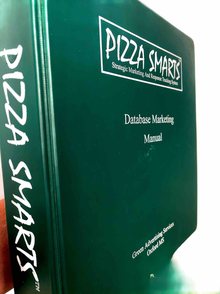
Download the complete manual
84 pages, re-typeset from the original binder: searchable text, the original illustrations and sample mailers, and the hand-colored battle map.
Download the PDF (9.5 MB)Read it chapter by chapter
Introduction
- Congratulations
- About the Author
- Welcome to Pizza Smarts
- Your Marketing Database
- The Pizza Smarts Marketing Process
- Marketing Activities Possible with Database Marketing
- Commonly Asked Questions
Analyzing Market
- Analyzing Your Market
- Market Penetration Analysis
- Marketing Battle Map
- Divide and conquer
- Customer Activity Report
- Qualitative Information
Developing Plan
- Marketing Strategies to Consider
- Marketing Plan Questionnaire
- Campaign Development Kit
Executing Plan
- Use MQR to select your target
- Preparing your own mailing
- Strategic doorhanging
- Telemarketing applications
Measuring Results
- Probe Mailings
- Pizza Smarts Case Study: Period to Period Statistical Comparison
- Rear View Mirror
- Using Your Mailing Response Report
Top Ten Marketing Promotions
- Top Ten Marketing Promotions
- Ten promotions with budget estimates per piece
- The 7 Ways to Sell More Pizza
- Offers Cooked Up For Each Customer Type
Why I’m Sharing My 1997 PizzaSMARTS Marketing Manual — For Free
PizzaSMARTS — Strategic Marketing and Response Tracking System
I believe that some of the most effective principles of restaurant marketing are timeless. Although technology has changed dramatically over the past 40 years, understanding customer behavior and communicating with customers effectively remains fundamental to building a successful pizza business.
That’s why I’ve decided to share this original 1997 PizzaSMARTS marketing manual.
My journey into computer-assisted pizza marketing began at my own Domino’s Pizza store at 3563 Sheridan Avenue in Buffalo, New York.
After developing a proprietary computer program and marketing algorithm, I discovered how dramatically sales could be improved by understanding customers, targeting the right households, and measuring the results of individual marketing campaigns.
Using these techniques, I tripled the sales of my own Domino’s store.
That experience led me to establish GreenMail in 1986, a computerized database marketing company that initially served Domino’s Pizza franchisees exclusively.
In 1990, when Domino’s decided to compete in the database marketing business, I created PizzaSMARTS to serve independent pizzerias, regional pizza chains, and other restaurant operators.
Between 1986 and 1997, GreenMail and PizzaSMARTS helped operators manage direct-mail, doorhanging, and telemarketing campaigns using proprietary software and marketing strategies.
Our services eventually expanded beyond the pizza industry. We applied these principles to a large video store chain, a pharmacy chain, and even a bank in Memphis, Tennessee.
What made these programs successful wasn’t simply the computer technology. It was the understanding that different customers respond to different messages, and that effective marketing requires identifying the right audience, delivering the right offer, and measuring the response.
The technology has changed. The underlying marketing principles haven’t.
Today, nearly four decades after I began developing these systems, we have extraordinary new capabilities involving digital ordering, artificial intelligence, customer loyalty programs, mobile communications, and sophisticated point-of-sale technology.
I believe these developments make the original PizzaSMARTS philosophy more relevant than ever.
As part of our work developing the Pizza Experience Platform, I intend to revisit and modernize these marketing strategies, combining the lessons learned from decades of restaurant marketing with today’s digital capabilities.
My goal is to make sophisticated marketing tools more accessible, affordable, and effective for independent pizzeria operators.
I’m sharing this original manual at no charge because I believe its principles can still provide valuable insights to restaurant owners, marketers, technology developers, and others interested in helping independent businesses become more successful.
I also hope it encourages new ideas, collaboration, and discussion about what the next generation of pizza marketing could become.
I welcome your comments, suggestions, and ideas.
About this edition
The only surviving copy of the manual was a three-ring binder, scanned page by page. This edition was re-typeset from that scan. The text reads as it did in 1997, including its original wording, spelling and names; the flowcharts, tables, worksheets and sample computer reports were reset, and the illustrations, sample mailers and battle map were restored from the scan. The one exception is arithmetic: calculation errors in the original tables and worksheets have been corrected.
For how these ideas work today, see the playbook.